
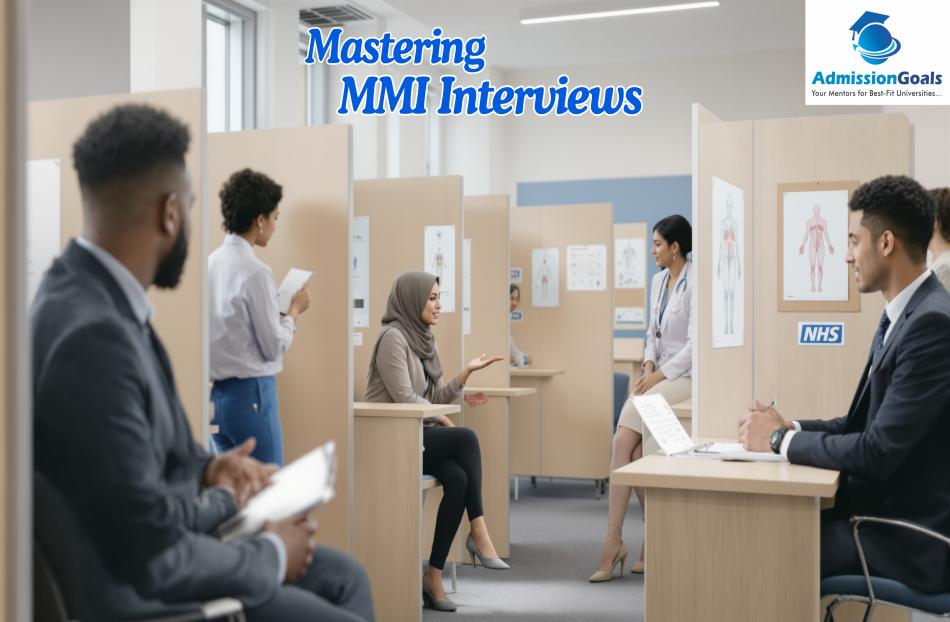
The UK medical school admission process has transformed because Multiple Mini Interviews (MMI) now use six to eight short stations which last between 4-10 minutes to evaluate candidates' medical aptitude and institutional fit. Medical schools now use the MMI format to conduct interviews which provides a complete assessment of applicants through its unique combination of short stations and role-playing activities.
The MMI format requires complete comprehension from anyone who wants to become a medical student. The MMI format differs from traditional interviews because candidates face different scenarios at each station which include question responses and task execution and patient news delivery role-plays. The interview stage stands as a vital selection factor because medical schools maintain acceptance rates between 3% for Harvard and 15-20% for Oxford and Cambridge.
Understanding the MMI Structure
Medical school admissions now use the MMI format which replaces traditional panel discussions with standardized station-based evaluations. The MMI format consists of short interviews lasting between five to ten minutes per station while candidates receive one minute to prepare before starting each station. The standardized format of MMI stations provides all candidates with equivalent testing conditions which leads to a more balanced assessment process.
The 2025 entry process at certain institutions combines online recorded stations during January with subsequent face-to-face MMI stations. The MMI format provides a complete evaluation system because it uses multiple assessors to assess candidates across different competencies which reduces personal biases while fully assessing their medical practice readiness.
Types of MMI Stations You'll Encounter
The MMI stations use specific designs that replicate actual medical situations which candidates will encounter in their practice. Candidates who understand the various station types can develop better preparation methods which enable them to handle each station effectively.
The Ethical Dilemma Stations within the assessment system require candidates to handle intricate moral situations which healthcare providers deal with frequently. The stations will present different scenarios which test candidates' ability to handle patient confidentiality matters and distribute resources and make choices about end-of-life care. Candidates need to show structured thinking while understanding different viewpoints and create logical conclusions while maintaining awareness of all affected parties.
The Communication and Role-Play Stations evaluate interpersonal abilities by creating simulated situations where candidates must interact with patients or handle difficult conversations. The candidates must perform three essential tasks during these stations which include delivering unpleasant information and describing treatment choices and offering comfort to upset patients. The stations evaluate communication abilities instead of medical information by measuring candidates' ability to show empathy and maintain professional conduct and deliver information clearly.
The Problem-Solving and Critical Thinking Stations assess analytical competencies through puzzles and mathematical problems and logical reasoning activities. The stations do not require medical knowledge because they evaluate candidates' problem-solving methods and their ability to organize thoughts and present their thought process effectively.
The Personal Reflection Stations examine three aspects of candidates which include their medical career motivations and their grasp of medical practice and their self-knowledge. The stations examine personal statements and work experiences and career goals to evaluate candidates' reflective abilities regarding their experiences.
Essential Preparation Strategies
The path to MMI success involves a structured method which builds particular competencies and general self-assurance. The path to MMI success focuses on showing medical school values through your thinking processes and personal qualities rather than achieving flawless responses.
Structured Thinking Development serves as the essential base for achieving success in MMI assessments. You should learn to present your thoughts clearly and methodically during timed situations. Learn to create adaptable question response frameworks which you can apply to various situations while keeping your approach flexible. The ability to divide complicated issues into smaller parts and evaluate different viewpoints and create sound decisions under time pressure should be practiced.
Comprehensive Self-Reflection is crucial for personal statement and motivation-based stations. The need to study their personal statements is crucial because any section could trigger process of deep self-assessment. The preparation process requires more than memorization of content because it helps candidates develop authentic understanding about their life experiences and career goals and personal drive.
Mock Interview Practice provides invaluable experience with the MMI format and timing pressures. The practice of mock interviews through regular sessions helps candidates develop self-assurance while enhancing their time management skills and revealing their weak points for improvement. The practice should include all station types to achieve complete readiness.
Communication Excellence in MMI Settings
The ability to communicate effectively proves more important for MMI success than any other factor including medical knowledge and academic performance. Medical schools understand that healthcare success depends entirely on healthcare professionals who can communicate effectively with patients and their families and their colleagues.
Active listening stands as the fundamental basis for delivering effective medical communication. Medical practice requires empathy which can be demonstrated through MMI role-play scenarios by showing patients you listen actively while asking questions for clarification and responding to emotional signals. The practice of active listening requires healthcare providers to identify the complete range of patient concerns and fears and needs which extend past their spoken words.
The ability to communicate clearly becomes essential when candidates face time constraints during MMI assessments. Candidates need to present complex medical information in basic terms while keeping their professional composure. The ability to explain medical concepts to non-medical family members or friends serves as an ideal way to prepare for these types of situations.
The way candidates present themselves through non-verbal signals plays a major role in MMI assessment results. The combination of direct eye contact with open body language and authentic facial ex
Ethical Reasoning and Professional Values
Medical practitioners need to handle intricate ethical situations while keeping patient care as their main priority throughout their practice. Candidates in MMI stations prove their ability to detect ethical problems and evaluate multiple factors before making decisions based on professional values.
Medical professionals use the four ethical principles of autonomy and beneficence and non-maleficence and justice to solve ethical challenges. The successful application of these principles in actual medical situations requires more than theoretical knowledge.
Medical practice confidentiality scenarios appear often in MMI assessments because they represent the core value of patient privacy in healthcare settings. Candidates need to show their ability to recognize situations where confidentiality rules apply and do not apply and to handle patient information requests and fulfill their duties to patients and their families and society.
Time Management and Common Pitfalls
The success of MMI interviews depends heavily on proper time management skills and the ability to steer clear of typical errors. The preparation time should be used to read questions thoroughly and determine essential points and create response frameworks. Start with direct answers to main questions followed by additional supporting information.
Over-preparation of scripted responses proves counterproductive because real interview questions rarely follow the expected formats. Students should learn adaptable response structures which enable them to answer different situations while keeping their answers natural and sincere.
The failure to use non-verbal communication methods results in substantial lost potential. The management of assessment stress requires professionals to maintain their composure through proper body positioning and direct eye contact and controlled facial movements.
The lack of deep ethical reasoning produces unconvincing answers which show no comprehension of medical professional duties. The evaluation process requires you to move beyond basic right-wrong thinking by understanding multiple viewpoints.
Your Path Forward with AdmissionGoals
The path to MMI preparation success depends on expert guidance and complete practice opportunities and individualized support that addresses personal strengths and development needs. The medicine admissions team at AdmissionGoals provides students with their extensive knowledge of MMI format preparation and medical school value-based professional development.
Our specialized medicine admissions consulting provides end-to-end support throughout your medical school application journey. We offer online study materials and classes for tests like UCAT, help with personal statement curation through brainstorming, and provide comprehensive application support including deadline management and submission assistance.
Our MMI preparation program combines individual coaching with comprehensive mock interview experiences that simulate actual assessment conditions. We provide detailed feedback on performance across all station types while helping students develop the confidence and skills necessary for MMI success. Beyond interview preparation, we offer complete application support including entrance exam preparation and strategic guidance on university selection based on individual profiles.
Don't leave your medical school dreams to chance. Contact AdmissionGoals today to begin your journey toward MMI success and medical school admission. Our expert team is ready to help you develop the skills, confidence, and strategic approach necessary to excel in this competitive landscape and begin your rewarding career in medicine.

